
page 11
To The Working Man
It was a rocky road to climb, in many ways, for Steve and Gini Foote, but no matter what The Stevedore did, Gini was always by his side. She is his constant companion and confidant. She is his greatest cheerleader and critic and treats him like a god. He, in turn, treats her as a goddess.
"When my son was staying with us, a couple of years back, he couldn't stand the way we were. He thought we behaved like teens, much too mushy the way we behaved. But that's just the way we are."
It is this love and devotion that has always existed between them that has shaped the course of their lives, and that includes the career of Stevedore Steve. Stevedore Steve has always been a mutual enterprise between them that has existed since first they met. Many a time, while sitting around the kitchen table at 46 Garden Street, it was Gini who urged him to play a certain song for us. Steve would get a little embarrassed and say something like: "Well, they don't really want to hear that dear," but we (whoever we were on that particular visit) would insist. Steve would rise from his chair and play with the ghetto-blaster, trying to find the place on the tape that he recorded this particular song. "Just bear with me, I'll find it somewhere's on this here thing."
He would write down the words and figure out a melody, working studiously, always trying to get that 'catch', that effect, that fisherman's hook that would grab the listener and reel them in. Many of his newer songs sound very similar, have that Merle Travis or Chet Atkins picking rhythm, a similar beat, and of course, his deep as the ocean voice that many compare to that of Johnny Cash. These simple melodies would then be recorded without the polish, just so that he had a reference, a record of the song in case he later forgot it. He would feel the response from subjects such as I, or Gerry Taylor, or anyone else that had the great fortune to sit and listen in that quaint basement kitchen, and perhaps, just perhaps, a certain song would make it. It might make a concert set list, or it might make it on to one of his recordings. That is when he would polish it up, get an interesting vocal arrangement, change a note or two, a chord or two, and add a lick to spruce it up.
In 1995, on the encouragement
of his success at the Miramichi Folk Song Festival, Steve recorded and
released another cassette, this time an ode to the working man. This time
it was recorded in his kitchen on a portable 4-track machine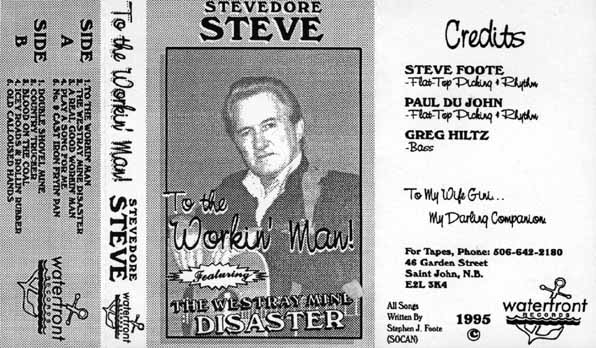 with
Paul Du John and Greg Hiltz. This tape suffers some of the productions
woes of the previous one but the playing is stronger, the angles are sharper,
the voice is more secure and the songs cover a fuller range. Every single
song on this cassette is a gem, including a tribute to the dredgermen who
risked their lives trying to save 26 souls trapped underground at the Westray
Mine shortly after that disaster in Nova Scotia. Without getting tacky
or syrupy, he navigates through a minefield ensuring that the listener
never doubts his sincerity on this very touchy subject.
with
Paul Du John and Greg Hiltz. This tape suffers some of the productions
woes of the previous one but the playing is stronger, the angles are sharper,
the voice is more secure and the songs cover a fuller range. Every single
song on this cassette is a gem, including a tribute to the dredgermen who
risked their lives trying to save 26 souls trapped underground at the Westray
Mine shortly after that disaster in Nova Scotia. Without getting tacky
or syrupy, he navigates through a minefield ensuring that the listener
never doubts his sincerity on this very touchy subject.
Many have not been so lucky. Trying to record a song about a recent tragedy can bring on a whole lot of trouble. Accusations of trying to cash in on the grief of others has lead to confrontations in the media if one is too quick off the mark. Stompin' Tom received plenty of pointed knives for having recorded his song about the Martin Hartwell incident in the Northwest Territories in the 1970s. Only weeks after the discovery of Hartwell's fate, Connors released a single that proved very controversial in that respect. He rode out the storm of criticism and left us with an excellent song to remind us of this incident. Not unlike the time he wrote a song about a labour conflict in Northern Ontario - The Reesor Crossing Tragedy - which saw a gunfight between striking mill workers and freelance farmers. When Connors tried to play the song in nearby Kapuskasing, the site of the pulp mill strike, even after 3 years, he was almost run out of town on a rail.
Wiz Bryant of Penticton, British Columbia, wrote and recorded a song about a train derailment near Hinton, Alberta, only to receive national exposure castigating him as a tasteless exploiter. Knowing Bryant I can assure you that this was not his intention. Nevertheless, he was knocked for having recorded the song too soon.
The Ocean Ranger incident in the early 1980s also inspired songs. Cape Breton native - now living in Halifax - David Stone wrote and recorded a Porcupine Award winning ballad called 26 Souls very soon after the Westray disaster.
Such songs used to be the norm, however. When Wilf Carter wrote and recorded the Rescue at the Moose River Mine in 1936 nobody flinched an eye. This was an age old way of preserving and remembering events of historic proportion.
Stevedore Steve took the clever route. Instead of using the political, emotional or sentimental aspects of the tragedy as his focus, he instead uses Westray to give us a look at the unsung heroes: the dredgermen, the mine rescue workers who risked their lives to try to get to those who were trapped below.
Stevedore Steve salutes working man on new cassette1
By the sweat on an honest working brow.It was obvious to Steve that he was not going to be taken seriously, receive any substantial radio play or make a record deal with these cassettes, but at least he could sell them to people at his performances. His real goal was to record a CD in a proper studio with a proper producerNow there is an often used quote Steve Foote understands: the life, lean far - a dollar short all too often - and the anxieties of Canadian working men.
From the waterfront of Saint John to the docksides of Vancouver with many work breaks in between - the Ontario tobacco fields, a Timmins mine, and Alberta oil rigs for instance - Stevedore Steve has stood in their shoes, with both feet in their steel-toed working boots.
Ready to tackle anything - that is the sign of a Real Good Working Man.
And a Real Good Working Man is just one song among ten originals Steve has included on a new cassette: To The Working Man, a tape package just back from a commercial copy maker in Toronto and now for sale.
Steve worked Canada-wide at jobs wherever he could get them during years of hitch-hiking and riding the roads with his long-time travelling companion, Stompin' Tom Connors, and later as a recording artist and club entertainer.
Like Connors, Steve is a song-scribe, a lyric mill who can churn out a dozen songs on any weekend and among the grist and chaff nearly always produce a gem or two. His new cassette of songs about the working man is comprised of what he considers the best of more than 400 he has written in the last few years since his interest in music was reignited.
Besides the title song, this cassette features 'The Westray Mine Disaster', which Steve considers one of his greatest epics, and my favourite, 'The Double Shovel Mine'. The Springhill Mine Disaster is also recalled in 'Blood On The Coal', so chalk three up for the miners on this tape. There are also two for the truckers, 'Icy Roads and Rollin' Rubber' and 'Country Trucker'.
This year he decided to go ahead with... To The Working Man, and was fortunate to have a friend lend him a portable four-track recorder. The result is not studio quality, you can hear the machine cut in and the hiss of the tape preceding each song, but there is much greater depth and sound spread to this cassette.
The wonderful flat-top finger picking and backing vocals of Paul Du John, half of Cricklewood, helps lift this tape up by the bootstraps as well. That, coupled with Steve's sonorous voice, so like that of Johnny Cash in timbre and depth, and his own delightful flat-top picking, make this an album well worth having for the lyrics and the celebration of the Maritime working man in song.
Notes
1. New Brunswick Telegraph-Journal,
July 15, 1995, Gerry Taylor
Back to the Index
On The Road Again, click HERE
© 1999 & 2010 by
Steve Fruitman for Back To The Sugar Camp ®